WEc1 Anticipated
Water Metering & Leak Detection
1
/ 1 points
- BMS with automatic leak alerts, internal dashboard
The water
Campus CIAE recycles 100% of treated blackwater and recovers technical rejects from softener, RO and AC. Everything returns to native landscaping. No waste in a desert region.
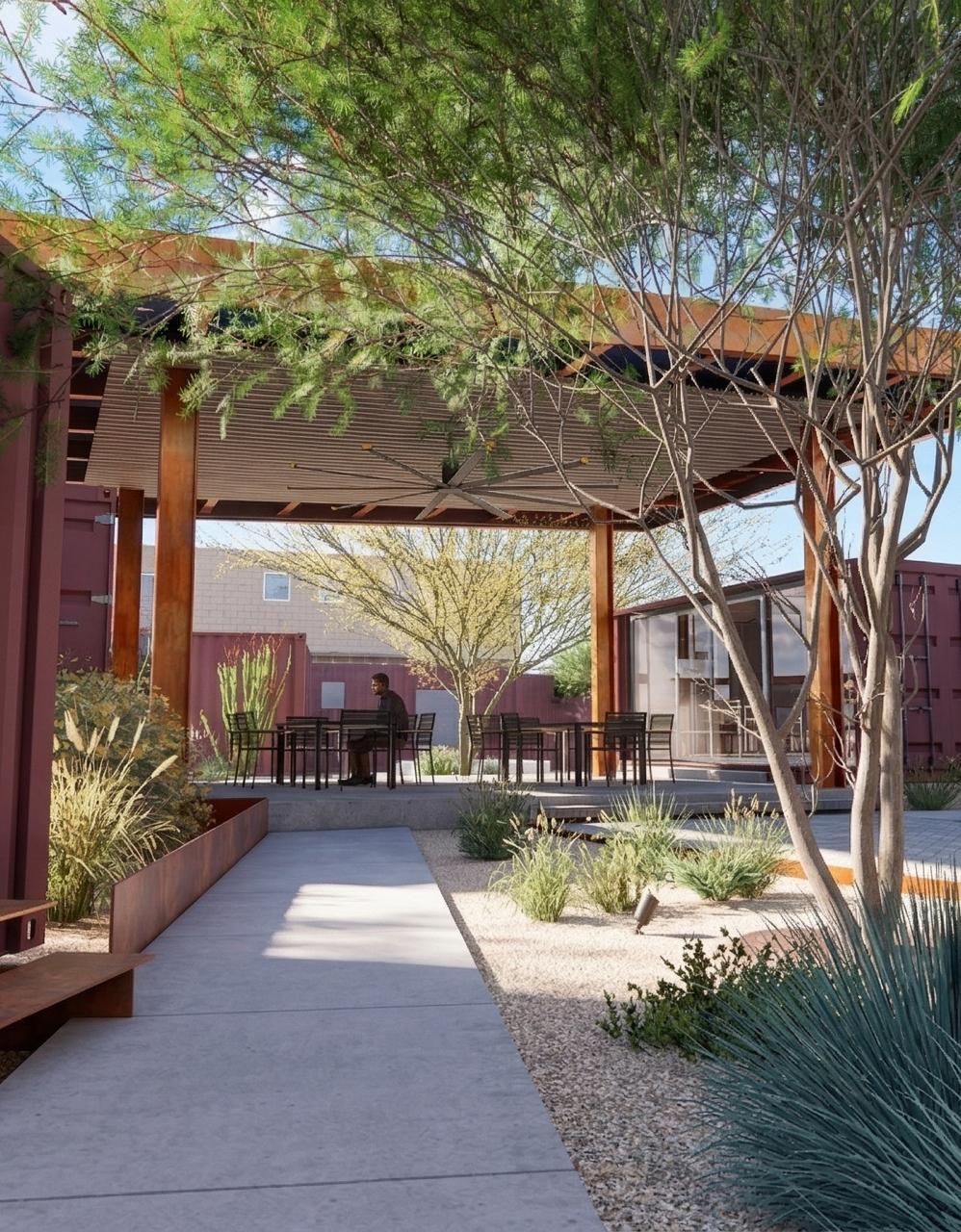
The challenge
Hermosillo receives 365 mm of annual rain, concentrated almost exclusively between July and September. It's one of northern Mexico's highest water-stress areas. The aquifer has been under extraction restriction for years.
Building a conventional building here — with decorative irrigation, no treatment, no reject recovery — would ignore the territory's reality. Campus CIAE responds with total reuse and landscaping that belongs to the desert.
The circuit
Municipal potable water from Hermosillo grid
Softener + reverse osmosis for critical areas (dining, showers, sensitive equipment)
WaterSense high-efficiency WC, low-flow lavatories, efficient showers. >30% reduction vs baseline
Lavatories and showers → dedicated treatment → landscape reuse
WC → treatment plant → NOM-003-SEMARNAT-1997 compliance → landscape reuse
Softener + RO + AC condensate → recovered → landscape immediate to containers
Native desert landscaping requiring minimal water once established
The treatment plant
The Campus CIAE treatment plant is sized for the building's operational volumes. NOM-003-SEMARNAT-1997 compliance for public reuse with contact.
Final technology — artificial wetland, compact MBR plant, or hybrid system — is confirmed in executive design phase. Tribo validates treated water quality in enhanced commissioning, with IAQ testing and continuous monitoring.
Passive strategy
Campus CIAE shipping containers don't rest on a slab. Each sits on elevated concrete pad foundations — a point-support system that leaves bare soil between supports.
This allows natural stormwater infiltration to subsoil, without requiring active capture. With only 365 mm annual, a cistern doesn't pay off — rainwater would supply a week of consumption per year, while the infrastructure costs for 50. Better to recharge the aquifer.
Native landscaping
519 m² of green areas. Zero grass. Zero exotic species. Once established, requires minimal reuse water.
Fouquieria splendens
Spring red flowering
multiple regional species
Extreme resilience, native biodiversity
Parkinsonia florida
Yellow flowering, shade and carbon
Olneya tesota
Endemic, longevity, wildlife habitat
Prosopis velutina
Key pollinator, wide canopy
Parkinsonia praecox
Photosynthetic green trunk
mix of low-growth species
Soil coverage without irrigation
Fixtures
All interior sanitary fixtures meet WaterSense or Mexican equivalent. >20% interior, >30% exterior reduction vs baseline.
Metering
Main meter + zone sub-meters connected to BMS. Automatic leak alerts + internal dashboard + monthly reports.
LEED v5
Water efficiency is where Campus CIAE most distinguishes itself: 9/9 possible points in WE category.
Project priority: PR2
Project priority: PR3
Project priority: PR2
Water is just one axis. The site's passive hydrology and campus materials are its complement.